Bill Mueller Bio Completed
Along the way, a few bios were skipped until they were completed. Here's a link to John Quinn's biography of the #74 Greatest Red Sox, Bill Mueller.
Along the way, a few bios were skipped until they were completed. Here's a link to John Quinn's biography of the #74 Greatest Red Sox, Bill Mueller.
Mike Greenwell, LF, #39 (1985-1996)
1269 G, 1400 H, 657 R, 575 2B, 130 HR, 726 RBI, 80 SB, .303 Avg, .366 OBP, .528 SLG, All-Star (1988-89)
But the Boston Red Sox fans at Fenway Park knew Mike Greenwell as a dependable left-handed hitter and leftfielder for a decade, from 1987-1996.
Michael Lewis Greenwell was born in Louisville, Kentucky on July 18, 1963. He grew up in Florida and attended North Ft. Myers High School, which also produced football stars Jevon Kearse and Deion Sanders. He was drafted by the Red Sox in the third round of the 1982 Amateur Draft and signed with the club.
Greenwell was brought up from Pawtucket in September 1985, and made his debut as a pinch-runner for Jim Rice in the first game of a doubleheader against the Cleveland Indians. That fall, the Red Sox were playing out the schedule and not in the pennant race, and Greenwell played in 17 games, went 10-for-31 and hit four homers and drove in eight runs.
Greenwell spent most of 1986 back at Pawtucket, as Rice was still the left-fielder. Greenwell hit 18 HRs and batted .300 at AAA. He was brought up again in August and saw action mostly as a pinch-hitter that year. But the Red Sox had a terrific team in '86, and Greenwell made the postseason roster. He played in both the ALCS and World Series, mostly as a pinch-hitter. He went 1-for-5 in that memorable postseason, but is best remembered for pinch-hitting for Roger Clemens in the eighth inning of Game 6 of the World Series. (This was the scenario that became controversial once the Series was over, as Clemens claimed he didn't want to come out, but manager John McNamara claims he did, because of a blister.) Greenwell struck out in that appearance.
1987 was a year to forget for the Red Sox and their fans, as the hangover from the 1986 World Series loss hung over the team all year, and they finished under .500. But it was a breakout year for Mike Greenwell. Jim Rice was moved to designated hitter and Greenwell was put in left field on a permanent basis. Greenwell responded with 19 HRs, 89 RBIs and a .328 batting average in 125 games. He finished fourth in the AL Rookie of the Year Award balloting (which was won by Mark McGwire).
1988 would prove to be Greenwell's best offensive season. He hit 22 HRs, 119 RBI and a .325 BA. He finished second behind Jose Canseco in the AL MVP Award voting (another loss to a "Bash Brother") and was a big part of the Red Sox comeback to winning the AL Eastern Division that season. Greenwell was also selected for the AL All-Star team for the first time, and hit for the cycle on September 14. He also won the Silver Slugger Award. But it was a disappointing postseason for the Sox and for Greenwell. They swept out of the ALCS by Canseco and the Oakland A's, and Greenwell hit .214 in that series with 1 HR and 3 RBI.
Greenwell would make the All-Star team again in 1989, hitting 14 HRs, 95 RBI and a BA of .308. He would have the longest hitting streak of his career that year, 21 games. His power numbers would continue to decline in 1990 and 1991, to 14 and 9, respectively. He also drove in just 73 and 83 runs, but his batting average was still around the .300 mark. Many of the Sox faithful thought Greenwell was a disappointment, as they thought he was next logical successor in that "golden position" of Red Sox leftfielder. He was a solid hitter, but not in the mold of the previous Red Sox leftfielders like Ted Williams, Carl Yastrzemski and Jim Rice. Greenwell was like Yaz was early in his career, a line drive hitter who wasn't a big home run hitter, and who could pepper the left-field wall with doubles. Greenwell was also just an average outfielder at best, and wouldn't win any Gold Gloves in his career.
1992 was a year to forget for Greenwell, as he battled injuries that year and played in just 49 games and hit .233. His offensive numbers would continue to slide in his final four years with the Sox, although he had a nice bounceback year for the Red Sox in 1995, as they won the AL East that year. He hit 15 HRs, 76 RBIs and hit .297. But the Red Sox were swept out of the playoffs for the third straight time, this time in the ALDS by Cleveland. Greenwell, who went 0-14 in the 1990 ALCS, went just 3-for-15 in the three-game sweep in '95.
Greenwell basically became a part-time player in 1996, hitting .295 in 77 games. He was a free agent after the season, and it looked like the Red Sox were going to let him go. But just before his Bosox career concluded, he had one final night of glory.
On September 2, 1996, in a game against the Mariners in Seattle, Greenwell drove in 9 runs, which was all of his team's runs, in a 9-8, 10-inning win at the Kingdome. It was a MLB record for most RBIs by one player driving in all of his team's runs. It was also a Red Sox record for one game, a record that still stands.
Greenwell's final game in a Red Sox uniform was overshadowed by what would be the last game by another Red Sox star player: Roger Clemens. As it would turn out, both Clemens and Greenwell would both depart Boston, and for teams based outside the United States: Clemens to Toronto, and Greenwell would head for Japan, to play for the Hansin Tigers.
It would be a disasterous move for Greenwell. It was a much-heralded transaction in Japan, but Greenwell would see action in just seven games, due to injuries. He would announce his retirement from baseball soon afterward.
He would turn his attention in his post-baseball career to another love of his: stock car racing. In May 2006, he made his Craftsman Truck Series debut at Mansfield Motorsports Speedway for Green Light Racing, starting 20th and finishing 26th. He also runs "Mike Greenwell's Family Fun Park" in Cape Coral, Florida, which includes a lot of activities like go-cart racing, miniature golf and batting cages. Greenwell is also a real-estate developer and an assistant baseball coach with Riverdale High School in Ft. Myers.
But Greenwell would get back in the sports headlines in 2005. When Jose Canseco released "Juiced," all about how his career was built on the use of illegal steroids, Greenwell went as far as demanding the he should be awarded the 1988 AL MVP Award away from Canseco.
He would tell the Ft. Myers News Press: "He's an admitted steroid user," Greenwell said of Canseco. "I was clean. If they're going to start putting asterisks by things, let's put one by the MVP. I do have a problem with losing the MVP to an admitted steroids user."
John Quinn is a writer who lives in New York City and runs the web site, "The Mighty Quinn Media Machine," and writes for the Red Sox fan site, Bornintoit.com, as "Brooklyn Sox Fan."
Bill "Spaceman" Lee, SP, #37 (1969-1978)
94 W - 68 L, 321 G, 167 GS, 578 K, 3.64 ERA, All-Star (1973)
"You should enter a ballpark the way you enter a church." - Bill Lee Author, Movie Star, Personality, Eccentric, Futurist, Intellectual, Political Activist, and (oh yeah) Professional Baseball Player. When you look back over the life and times of William Francis Lee III, it's easy to remember him more for his peripherals than his performance on the baseball field. But should you think that Bill "Spaceman" Lee was more personality than ball player, then you are sorely mistaken. For all his off-field activity, his performance on the field is just as memorable as every off color comment, socio-political rant, or autobiography. In fact, Bill Lee is one of the best left handed pitchers every to put on a Boston Red Sox uniform.
Bill Lee was born with baseball in his blood in Burbank, CA on December 28th, 1946. Both his father and grandfather played the game with a passion, but it was his aunt Annabelle Lee, whom Bill Lee would call the "best athlete in the family." Also left handed, Annabelle Lee was a star in the Women's Semi-Pro Hardball League in Chicago.
Bill Lee stayed in his home state to play college ball at the University of Southern California where his Trojans won the College World Series in 1968. Lee graduated after that season and was drafted by the Boston Red Sox in the 22nd round of the 1968 Amateur Baseball Draft.
Upon finding out that his son had been drafted, William Lee Jr. gave Bill the following advice; "Son, you're joining the Boston Red Sox, a fine organization. Now if you can pitch like we both know you can and you can keep your mouth shut, you'll end up being with them for a very long time."
After spending only one year in the Red Sox minor league system, blowing through the Midwest League, Carolina League, and AA Pittsfield of the Eastern League where he went 6-2 with a 2.06 ERA to start the 1969 season, it was apparent that Bill had at least taken the first half of his father's advice.
On June 24th, 1969, Bill Lee was called up to the big leagues when Jim Longborg was hurt. According to Lee, the last thing that he was told after getting the call was not too pack to heavy a bag and not to expect to be up for too long. "Nine years and 102 days later, I was gone," Lee would quip in his autobiography The Wrong Stuff.
Lee didn't get off to the best start in Boston. His first appearance in the Major Leagues would come on June 25th in relief against the Cleveland Indians at Fenway Park. He would go four innings giving up just one run and two hits while striking out five and walking three. Lee would end up the staying with the club the whole season in a relief role, going 1-3 with a 4.50 ERA with one start at the end of the season. Lee called his performance in his first season "really horseshit." Known primarily for his control and his breaking pitches, Lee found himself throwing alot of fastballs and not really getting into the groove with his breaking pitches with the adrenaline that would come working in short relief.
Lee would start the 1970 season with the Red Sox pitching in eleven games with five starts going 2-2 with a 4.62 ERA before he was called into the Army where he served as a reservist. Lee would call military life "interesting, a mixture of perfect logic with a huge helping of the absurd." Despite his eccentricity, Lee served his time in the Army without note and would return to the Red Sox in time to start the 1971 season.
Lee would begin to settle in as a reliever in Boston over the next two seasons pitching in 47 games each year going 9-2 with a 2.74 ERA in '71 and 7-4 with a 3.20 ERA in '72. Come 1973, Lee would break into the starting rotation where he excelled for three straight 17 win seasons. An All-Star in his first season as a starter in 1973, Lee would finish the season third in the AL in ERA (2.75).
In 1975 along with Louis Tiant and Rick Wise, Lee anchored the American League pennant winning Red Sox rotation. With the Red Sox up one game to none against the vaunted National League Champion Cincinnati Reds, Lee made his first postseason start going eight strong innings giving up only two runs on five hits before leaving with a 2-1 lead on the verge of putting the Red Sox two wins away from a World Series Championship. The Reds would go on to score two runs in the top of the ninth off Dick Drago to win the game and Lee's performance would go wasted. The series would continue with the Reds up 3-2 when Bernie Carbo and Carlton Fisk's dramatics in game six would tie the series and force a seventh game. Lee would be called on to pitch game seven of the 1975 World Series at Fenway Park. Lee would pitch 6 1/3 shut out innings with the Red Sox leading 3-0 before giving up a two run home run to Tony Perez off an ill-conceived "Leephus" pitch.. Lee would leave game seven up 3-2 only to watch the bullpen lose the second game that he had started that series.
Following three 17 win seasons, 1976 began a downturn in Lee's career, but not before one last bit of fireworks. Lee was involved in many moments in Red Sox history, but arguably the most famous one came in 1976 when he was forced to leave a game after hurting his shoulder in a bench clearing brawl with the New York Yankees. Lee would go 24-22 over his last three seasons with the Red Sox posting ERAs of 5.63, 4.43, and 3.46 before being traded to the Montreal Expos before the 1979 season for utility infielder Stan Papi. Lee who had previously railed against the organization for trading away teammates like Bernie Carbo shot his way out of town, hiding his disappointment, saying, ""Who wants to be with a team that will go down in history alongside the '64 Phillies and the '67 Arabs?"
Lee would finish his Red Sox career with the third most wins for a left handed Red Sox pitcher behind only Mel Parnell and Lefty Grove winning 94 games over his ten year Red Sox career.
Lee would pitch well in his first season in Montreal going 16-10 with a 3.04 ERA in 1979. He would leave baseball altogether in protest over the release of a teammate in 1982. Lee claims that he has been blackballed from baseball since his walkout.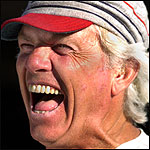
Even today at over 60 years old, Lee estimates he still throws 200 innings a year playing the game he loves in over-40 leagues in New England.
"I think about the cosmic snowball theory. A few million years from now the sun will burn out and lose its gravitational pull. The earth will turn into a giant snowball and be hurled through space. When that happens it won't matter if I get this guy out." - Bill Lee
This Top 100 Red Sox profile was written by Tim Daloisio, Editor and Chief Blogger of the Red Sox Times.
A quick admin post to give an update on the list and an explanation for the silence for the past few weeks. To tell the truth, we got off to a great start, but the 2-a-days were a bit much and it finally caught up to us.
Many of us got caught up in work, family, Spring Training, etc. But no worries, the list soldiers on.
I am working on an updated schedule scaling back to a player a day from here on out. To all of our tireless writers; thanks for all your hard work this far and we're going to see it through! Be on the lookout for an email from me shortly with the revised schedule.
Bruce Hurst, SP, #47 (1980-1988)
W-L 88-73, 237 G, 217 GS, 54 CG, 13 SHO, 4.23 ERA
"It hurts a lot more to lose than it feels good to win." - Bruce Hurst Looking back through the numbers, nothing about Bruce Hurst stands out in particular. His 4.23 ERA over the course of his Sox career certainly seems pedestrian. He was, however, outstanding backup to ace Roger Clemens in the mid-80s, along with Oil Can and Al "Cheez" Nipper. Hurst was a crafty left-hander whose career in Boston was solid, and whose 1986 WS performance should have been legend.
Hurst spent 1980-81 mostly in Pawtucket, riding the Merloni express in 1980 and starting five games at the tail-end of 1981. While in Pawtucket, he pitched in the longest game in professional baseball history. Hurst was the 7th pitcher for the Paw Sox, and did his part to extend the game, throwing 5 scoreless innings.
He finally got a chance to stick with the big club in 1982, starting 19 games out of his total of 28. He had a poor ERA, probably somewhat due to his 1.718 WHIP. The Sox FO must have seen something, because he was allowed to continue after such a performance. (It would seem rash to judge such a pitcher at age 24.)
In 1983, Hurst would begin to show his consistent ability to be a league-average or better workhorse. 1983-85 were all seasons closely resembling the others. His ERA+ would hover right around 100, and a WHIP around 1.4. He would throw 200+ innings each season, while steadily increasing his Ks.
1986 would be the best season of Hurst's career, though he spent six weeks on the DL. He would post his lowest regular-season WHIP in a relevant league, win 13 games, while completing 11 of his 25 starts. He saved the best for the postseason. In the World Series, he won 2 of his 3 starts, and put the Sox in position to win the 3rd in game 7. Hurst would have been named WS MVP had the Sox been the victor. It was not to be. However, no less than Mets slugger and clean-image poster boy Darryl Strawberry would praise Hurst's performance in the Series: "Clemens is tough, but he's no Hurst."
Indeed, Hurst would rise out of Clemens' shadow only to be foiled by an inability to replace Bill Buckner with Dave Stapleton. The champagne was on ice, the media was ready to cover Hurst in a suffocating manner, and the Sox brass was ready to receive their rings and kudos. Unfortunately for Hurst and the Sox, one ground ball and a giant heap of blame on one player would prevent the win.
1987 and 1988 were both successful seasons for Hurst. He would gain All-Star recognition in 1987, winning 9 games and pitching 139 innings before the break. In 1988, he would reach his career high win total of 18, and finish 5th in the Cy Young balloting. Such a win total and his 5th place non-award made him a hot commodity on the FA market. His Sox career would come to a close when he chose less money to pitch closer to his probably not polygamist roots in Utah.
Hurst would pitch five seasons in the fledgling semi-pro NL West before he retired as a Texas Ranger in 1994. He, however, was not done with baseball. He is now the pitching coach of the Chinese national team under manager Jim Lefebvre. He seems to relish the challenge and looks forward to competing in the 2008 summer Olympics in Beijing.
Allen once ate a live snake, spine and all. Just kidding. Snakes don't have spines. Find out more at Over The Monster.
Dutch Leonard, SP, #N/A (1913-1918)
W-L 90-64, 211 G, 162 GS, 96 CG, 25 SHO, 2.13 ERA
Hubert Benjamin "Dutch" Leonard was born on 16 April 1893 in Birmingham, Ohio. He pitched for two seasons in college and one in the minors before getting his shot in the Majors. His BR Bullpen profile mentions a trial in 1911 with the Philadelphia A's. Legal troubles? Did they mean tryout? Research-backed answers get a cookie. He would break into the bigs with the Red Sox as a 20 year old in 1913.
What do we need to know about Dutch Leonard? Leonard was a part of three teams that would go on to WS titles in his career with the Red Sox. The only downside was having to play second fiddle to Babe Ruth for most of that time. He was an excellent pitcher in his own right, averaging over 16 wins a season over his 5 1/2 years with the Sox. Dutch was also a spitballer, and one of the pitchers allowed to continue throwing the pitch after it was banned in 1920.
Dutch's first season, 1913, was successful and unsuccessful. His ERA+ was a solid 122, with a WHIP of 1.307. However, he won only 14 and lost 17, being a good example of why wins and losses aren't a great way to judge a pitcher. The 1913 team finished fourth in the American League. He was on the verge of one of the greatest seasons ever by a starter.
As sophomore slumps go, Dutch didn't have one. He set the modern-day record for ERA at 0.96 with a staggering ERA+ of 279 over 224 2/3 IP. He would go as high as 16th in the MVP voting at the end of the season winning 19 games and helping the Sox move from 4th to 2nd place that season. One would hope, with the years to come, that even Leonard wouldn't see the 0.96 ERA as his crowning achievement.
1915 was an exciting season for the Sox. The first full season for Babe Ruth ushered in a WS title. The Sox would finish the season with 101 wins. Leonard had a good season, but after his phenomenal 1914, one might think it was a let down. Hopefully the WS trophy reduced some of the sting.
The next season was more of the same. Leonard won 18 in support of staff ace Ruth, and the Sox would win another title. Dutch did throw a no-hitter this season, against the St. Louis Browns, on 30 August. It's important to note that Dutch tossed a complete game win in both Series in which he appeared. While Leonard would be a part of the 1918 squad, he would never pitch another World Series game in his career.
Dutch reached a career high in complete games in 1917, finishing 26 of those contests he started. How weak are today's pitchers compared to that era? Dutch would finish only fifth in the league in that category. The Sox would finish nine games behind the White Sox that season, probably due to the departure of Tris Speaker. The Sox as a team held an ERA of 2.20, so it would seem hard to blame anyone but the offense.
1918 was Leonard's last season with the Sox, and he would only pitch half the season, missing time due to service in WWI and some time spend building ships. He would find time to pitch his second and last no-hitter, against the Detroit Tigers on 3 June. He would move on to the those Tigers in 1919, finishing his ML career in the Motor City. However, as with almost all human beings, his life was not without some significant controversy.
First of all, Dutch had a bit of a history with Tigers' superstar and all-around nice guy Ty Cobb. I'm going to let Ty Cobb dot org handle this one: In 1914, Red Sox pitcher Dutch Leonard hit Cobb in the ribs with a fastball. In the next at bat, Cobb bunted the ball down the right side line. First baseman Clyde Engle covered the play, turning to toss the ball to Leonard just as Cobb spiked him.
Basically, the two had a pleasant history before Leonard arrived to play for Cobb's Tigers. He would never enjoy the same success he had with the Sox, but he was able to arrange some game-fixing while he was there. The story goes like this: Dutch was involved in game-fixing with Ty Cobb and Tris Speaker while he was a Tiger. Ex-Sox pitcher Smokey Joe Wood would also be implicated. Leonard would mostly hurt himself with this, until he produced documentation in 1926 that the incident did, in fact, occur. Speaker and Cobb would be released by their teams after the season. Leonard had already finished pitching the season before. It's important to note that the players did not throw the game for bettors. Quite simply, the Tigers could move into third-place for extra money.
Leonard would not return to baseball. He would become an accomplished wine-maker and a successful golfer. He died at the age of 60 because of complications due to stroke.
Allen once ate a live snake, spine and all. Just kidding. Snakes don't have spines. Find out more at Over The Monster.
Bob Stanley, CL, #46 (1977-1989)
115-97, 637 G, 132 SV, 3.64 ERA Bob Stanley, nicknamed “Steamer” because like the Stanley Steamer vacuum, he sucks, is perhaps the best Red Sox player to be almost universally disliked in the popular imagination. Roger Clemens may be hated by many, but others still love him. Jose Offerman and Mike Lansing might be derided, but they weren’t terribly good, but ol’ Bob Stanley was both awfully good and awfully disliked by the Red Sox faithful.
Be honest, have you ever met a Bob Stanley fan? (Note: Okay, at his Baseball Reference page his fenwaynation.com sponsors describe him as “Forever beloved for plunking Mike Barnacle at the 1992 Sox Fantasy Camp In Winter Haven.” But they don’t count. And have you noticed Jose is borrowing heavily from Baseball Reference in these? Wikipedia too, but now that he’s mentioned it, it’s not plagiarism.)
But why was Bob Stanley so disliked? Was it his wild pitch that allowed Mookie Wilson to score the tying run in Game 6 of the 1986 World Series? Nope, every one knows that was a passed ball. Beside, Dave Stapleton should have been pitching, or something like that. Was it the relish with which he played his role as the bullpen fun police and heartless killjoy? Possibly, this is the guy who ceremonially popped a beach ball with a rake on his appreciation night at Fenway. Really. Still, probably not.
No the reason, that Bob Stanley is widely unloved despite being the Red Sox All-Time save leader with 132, despite having a career ERA of 3.64, despite being a two time All-Star is that Bob Stanley, for all of his excellence, never, ever allowed fans to feel safe when he entered a game. Even in 1983 when he was second in the A.L. in saves with 33 and plunked down a nifty 2.85 ERA, did you ever relax when he entered a game? No, you didn’t, unless you responded to his entering a game with 50mg of valium.
A while ago, Jose suggested that a new statistic be named after Steamer. He suggested that when a reliever picks up a win after blowing a lead, effectively stealing the win, he should be credited with a “Stanley.” Look at his numbers. In 1983, arguably his best season, Stanley saved 33 games while blowing 14 saves, tying a major league record. At the same time, he had eight wins and 10 losses. Do you ever feel good when your closer has that many decisions? Chances are quite a few of those wins should be scored as Stanleys.
Yes, yes, the single season blown save record is shared with a couple of pretty good pitchers named Fingers and Sutter, but still, 14 in a year? Only in a situation like that, could Calvin Schiraldi swipe the closing job.
Player bio by Jose of Jose's Keys to the Game


